Data Mining with Nitr-Navigator

Nitr-Navigator combines detailed food, sampling and analytical fields to support transparent data filtering, food matching and source-specific nitrate and nitrite intake assessment.

By Liezhou Zhong
Updated June 20, 2026

From Food Classification to Intake Estimates

The AJCN study used a structured food-group framework and a stepwise extraction protocol to translate heterogeneous food records into comparable nitrate and nitrite estimates.

Supplementary Figure 2S

Food Group Classification

Dietary nitrate and nitrite sources are organised into water, plant sources, animal sources and other foods. The hierarchy supports consistent food matching, aggregation and source-stratified intake assessment.

Food Grouping Framework for Dietary Nitrate and Nitrite Assessment
1.0 Water
2.0 Plant sources (PS)
2.1 Fruits and vegetables
2.1.1 Fruits
2.1.2 Vegetables
  • 2.1.2.1 Green leafy vegetables
  • 2.1.2.2 Potatoes
  • 2.1.2.3 Other vegetables
2.2 Grains
2.3 Nuts, oils and other plant sources
3.0 Animal sources (AS)
3.1 Meat and fish
3.2 Processed meat
3.3 Dairy, eggs and other animal sources
4.0 Other foods
4.1 Alcohol
4.2 Discretionary foods, condiments and miscellaneous foods

Select a group to show or hide its lower-level classifications.

AJCN Figure 7

Stepwise Data Extraction

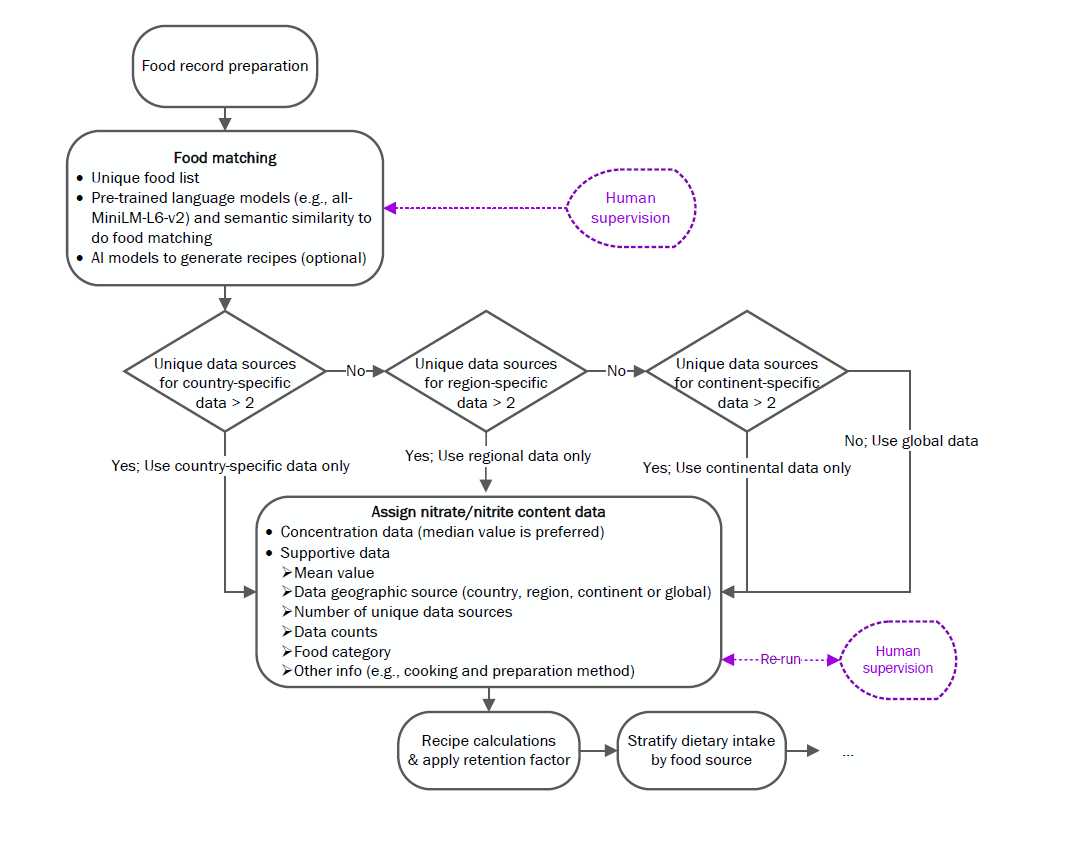
Food records are matched under human supervision, then assigned country-, region-, continent- or global-level concentration data according to data availability. Median values are preferred before recipe calculations and food-source stratification.

Open full-size figure
Stepwise workflow for food matching, geographic data selection, nitrate and nitrite assignment, recipe calculation and intake stratification
Stepwise extraction and assignment workflow presented in Figure 7 of the AJCN paper.

Key Research Questions

The study addresses three questions relevant to applying the database in clinical and epidemiological research.

  1. Question 1How do growing seasons influence nitrate and nitrite levels in plant-based foods?
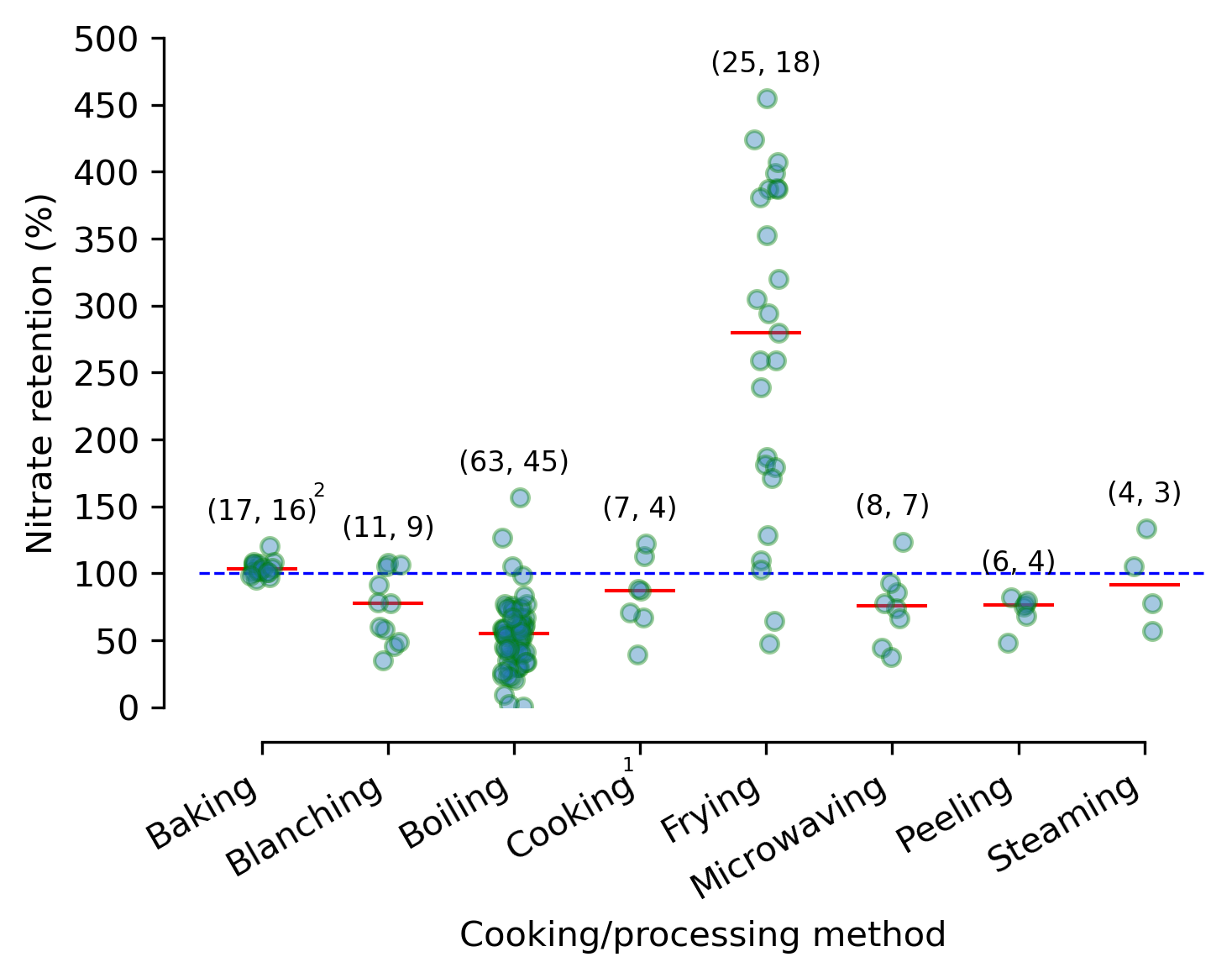
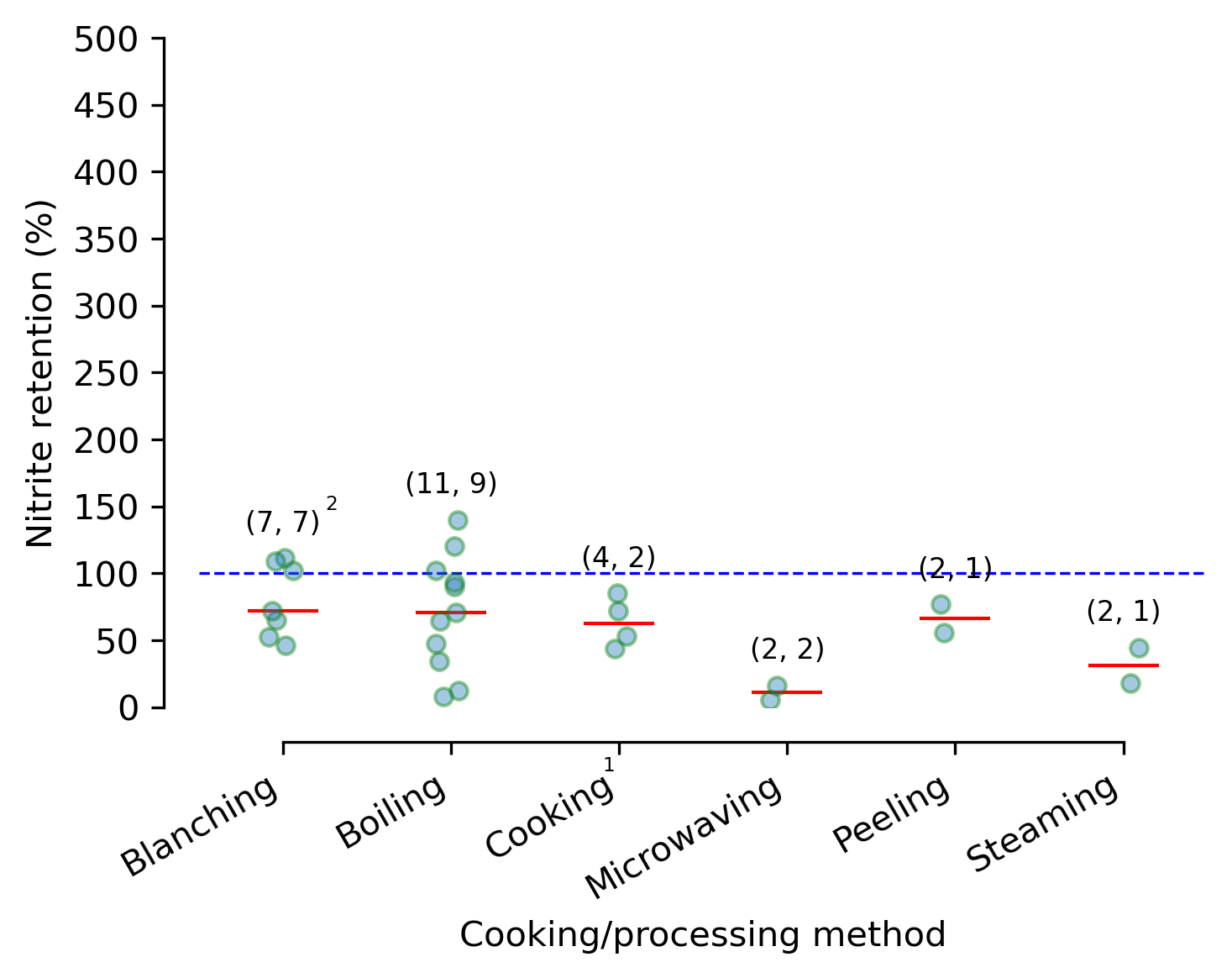
  2. Question 2What are the potential impacts of different cooking methods on nitrate and nitrite retention?
  3. Question 3How has the nitrate and nitrite content of foods changed over the past 30 years?

Seasonal Variations in Nitrate Content

Key Seasonal Insights

  • Leafy vegetables show strong seasonality: higher in winter, lower in summer.
  • Root vegetables remain relatively stable with no clear seasonal pattern.

A noticeable pattern emerged, revealing that nitrate contents of vegetables sampled during warm months, particularly June and July, were consistently lower than those in the cold season for leafy vegetables but not for root vegetables.

Impacts of Cooking Methods on Nitrate and Nitrite Retention

Nitrate retention by cooking method Nitrite retention by cooking method
Note: 1, cooking method unspecified; 2, number of data points/foods and number of unique foods included.

Boiling

Substantial nitrate loss due to leaching into cooking water (median ~55%).

Steaming

Better preserves nitrate with minimal loss compared to boiling.

Frying

Highly variable; some foods exceed 100% due to water loss.

Nitrate retention (%) in boiled vegetables (median [IQR], 55.00 [39.59–65.56] %; n = 63) consistently fell below 100%. By contrast, frying often increased apparent nitrate levels (median [IQR], 279.53 [179.53–386.89] %; n = 25). Steaming and baking generally preserved more nitrate, while blanching (median [IQR], 77.78 [53.33–98.35] %) showed moderate retention.

Decadal Changes in Nitrate Content

Highlights (1990–2020)

  • Kale and romaine lettuce saw the steepest declines in nitrate levels.
  • Chinese white cabbage remains one of the richest sources, despite some fluctuations.
  • Spinach shows moderate decline but continues to rank among nitrate-dense vegetables.
  • Overall, many leafy greens show a downward trend, suggesting shifts in agricultural practices and cultivars.

Cite this page

Zhong, L., Hodgson, J. M., Lewis, J. R., Blekkenhorst, L. C., Bondonno, N. P., Sim, M., Woodman, R. J., & Bondonno, C. P. (2025). Nitrate and nitrite food composition database: An update and extensive deep dive. The American Journal of Clinical Nutrition, 121(5), 1124-1136. https://doi.org/10.1016/j.ajcnut.2025.01.031
✅ Copied Successfully!